Dear Edwards Church Community,
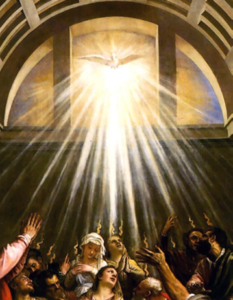 On Pentetcost morning most of the Christian world, including the congregation of Edwards Church, gathered to celebrate the gifts of the spirit to all communities around the world that gather to carry on the ministry of Jesus. All the different communities are encouraged and guided by the same spirit that was in Jesus, as much as they are open to it.
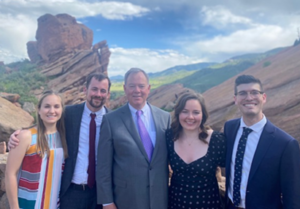
While the congregation of Edwards gathered in our sanctuary on May 28, I was nervously walking around Denver, CO with notes of what I had prepared to say about my nephew and his beloved, whose wedding I would officiate a few hours later. I was not happy with what I had prepared. The content was good, but it was too formal for this young couple. So I walked and prayed for inspiration, not so much petitioning God to make my words better, but to relax my heart, mind and spirit to be supple enough to live into the moment and trust the Spirit that connects us all to help me express what I wanted to share appropriately.
 Ginger and Riley were thrilled to be finally married. The gathered families and friends appreciated all the words spoken by me and others. Those words were both tailored to the moment and still timeless. As the bride said in her personally prepared vows: “What is it, in ten or twenty or seventy years, that will make this wedding … this amazing day, seem dated? The style of our clothes, I’m sure. … This day, our wedding day, will be tucked in the folds of time, to remember and to cherish. But our marriage, that which begins today, will go on, constant but dynamic, growing, adapting. For though we may look back and laugh at our haircuts, the expressions of joy we wear today will be the same, ten or fifty years from now.”
The setting of the wedding was one of the couple’s favorite locations, Red Rocks outside Denver. The geological age of the venue creates a stunning backdrop, with exposed rock surfaced recently in geological time, only tens of thousands of years ago, while the Rocky Mountains themselves are much older, at 35 to 80 million years. With my family duty fulfilled, I was free to enjoy the festivities and, between moments of celebration, do what one naturally does, i.e., wonder what it all means.
I came away from this important gathering to celebrate a new marriage, on a weekend when Christianity as a movement celebrates the birthday of the church, more convinced than ever that it matters – more than we like to admit – that we communicate to our children and grandchildren not the importance of how Christianity is currently expressed (or was when we were younger), but the why it matters
My nephew and his spouse are both wonderfully compassionate, ethical people. Both were baptized and exposed to organized Christianity. Both have parents that cared enough about church to get them there. But neither of them cares about church now or wanted any explicitly religious language in their service, because it does not speak to them. And they exemplify their generation.
 The spiritual lives of the children and grandchildren of Boomers typically have less to do with the way we worship and much more to do with how we address persistent social problems. Not because younger adults are uninterested in spiritual life, but because a spiritual life that is not clearly connected to practical service and moral-ethical living is neither persuasive nor interesting to them.
The way we do church matters, but staying focused on why we do it matters more. If we are embarrassed to talk about why we are drawn to worship and service, then we are probably not going to grow. What might you say when someone whose love and approval you no longer need to worry about asks why you go to church? The kind of church we will have in the future is built on the answer. The research is clear on this: new members of churches overwhelmingly come from people who hear about it from current members.
In her letter, Deb invites us to consider some spiritual reading and discussion. I plan to join. I hope you will too. We are all people who wonder about the meaning of it all. We all have thoughts about life, about God and Jesus (I hope), and what difference it makes whether and how we love God and neighbor. Maybe practicing talking about this first with each other will make it easier and more natural to talk to others about such things with friends and strangers. Only one way to find out.
In faith, with hope, for love,
Michael
From the Minister of Faith Formation
Dear Beloved of God,
A virtual retreat Friday night June 2 through Saturday June3rd will bring to culmination an eight-month Shalom Institute for Spiritual Formation program titled Heart Longings: An Invitation to the Contemplative Path that I and twenty-five others from four countries have been participating in. Interest and participation in this program was personal – my own spiritual self-care.
Some gleanings from the various seminars have been shared in previous newsletters such as exploring the question what if paying attention to what we long for is part of how we find God’s longing for us; some links to YouTube videos or short documentaries were shared. Reflection and journaling were sparked by the wisdom of Rumi and Hafiz such as:
“You are – we all are- the beloved of the Beloved, and in every moment, in every event in your life, the Beloved is whispering to you exactly what you need to hear and know…listen and you will discover it…”1
The Seed Cracked Open
It used to be
That when I would wake in the morning
I could with confidence say,
What am “I” going to do?
That was before the seed cracked open.
Now Hafiz is certain:
There are two of us housed
In this body…
Now when I awake
All the internal instruments play the same music:
God, what love-mischief can “We” do for the world today?2
Required reading included selected chapters in books by Gerald May (The Awakened Heart: Opening Yourself to the Love You Need), Christine Valters Painter (The Artist Rule: nurturing your creative soul with monastic wisdom), Lauren Artress (Walking a Sacred Path), John Phillip Newell (Listening for the Heartbeat of God: A Celtic Spirituality), Charles Marsh (The Beloved Community – How Faith Shapes Social Justice, From the Civil Rights Movement to Today) and full texts by Howard Thurman (Jesus and the Disinherited), and Lerita Coleman Brown (What Makes You Come Alive: A Spiritual Walk with Howard Thurman).
Each of the seminars, along with a required monthly group spiritual direction component, have nurtured, expanded, caused reflection and humbled me along my continued spiritual journey.
I continue to reflect on many of the readings, participation in this experience, and am particularly grateful for the April seminar on “Sacred Activism: Contemplative Grounding for Social Change” led by Lerita Coleman Brown which focused on the contemplative mystic Howard Thurman. Howard Thurman made a connection between contemplation and social justice. He was a spiritual mentor to Martin Luther King, Jr., Bayard Rustin, James Famer, James Lawson, Jesse Jackson, John Lewis and many others during the Civil Rights movement. He continues to mentor many today, myself incuded.
Thurman, in his book, Jesus and the Disinherited, begins by stating three facts about Jesus: (1) Jesus was a Jew, (2) Jesus was a poor Jew, (3) Jesus was a member of a minority group in the midst of a larger dominant and controlling group.3 In her presentation, Lerita Coleman Brown, quoted Thurman as saying “I am not representing the religion about Jesus, that is the religion that oppressed and also had a lot to do with domination and subjugation; the religion of Jesus is though, a liberating religion and a religion the oppressed can own, because Jesus was oppressed. Your thoughts?
In our noise filled world and lives, Lerita Coleman Brown also offered Howard Thurman’s three pillars of the spiritual path to assist in strengthening, facilitating, bringing peace and healing to our spiritual growth: silence, stillness, and solitude. She suggested we allow ourselves “pause pockets” one, two, or three minutes of silence throughout the day. Perhaps this is something many of you already practice. If not, what would that look like for you…for our youth?
Once, when Howard Thurman was asked his advice for what needed to be done in the world, he responded, “Don’t ask what the world needs. Ask what makes you come alive and go do that, because what the world needs is more people who have come alive.” As we head into the summer months, I invite you to ponder the question: what makes you come alive? and to invite others – family members, church members, friends, co-workers, etc. to ponder the same question. As always, I am not asking you to do anything I wouldn’t do; that question continually gives me cause for pondering and also looking for the aliveness around me.
Blessings, and safe travels during the summer months.
Deb
1 Jelaluddin, Rumi, Light Upon Light: Inspirations from Rumi by Andrew Harvey.
2 The Seed Cracked Open by Hafiz in The Gift:Poems by Hafiz translated by Daniel Ladinsky.
3 Thurman, Howard. Jesus and the Disinherited Beacon Press, MA. 1976, ppg 3-8.
To read the full SPIRE click here.