Dear Edwards Church Community,
Rainn Wilson is a successful working actor, famous for playing the character Dwight in the long running hit TV show The Office. With his new book, Soul Boom: Why We Need a Spiritual Revolution, the comedic artist best known for portraying a doofus shares surprising insight on what it means to be spiritual and religious in our society.
He has no hesitation in sharing his conviction that God is real: “The first step in knowing that there is a creative force in the universe is I know that there is love. I also know that there is beauty. I also know that there is art and there is music. And all of these things that are ineffable and transcendent are footprints. They’re handholds on the path to finding the great mystery.” https://www.npr.org/2023/04/25/1171786870/rainn-wilson-urges-a-spiritual-revolution-in-his-new-book-soul-boom
 I was impressed by an interview that aired on April 25, in which Rainn Wilson talks about wandering away from the Baha’i tradition in which he grew up and returning to it later, especially by how thoroughly Mr. Wilson integrates both his spiritual questions and convictions into daily life. He found, as a young man, that he did not believe in the God his childhood education provided or that popular culture provides. But still as a young, struggling actor in New York, he would ask people he had just met at parties, “Do you believe in God?” As he says, he was always considered a nerdy guy, and not just by casting directors, but he was OK with that.
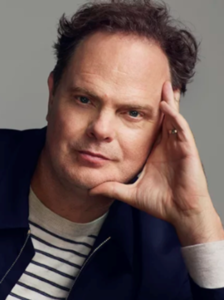 His ranging curiosity and persistent effort to make sense of spiritual matters across all areas of life moved him to speak out now. “There has been a profound loss of the sacred in contemporary Western civilization. Nothing is sacred anymore. And I think sacredness and holiness is part of the conversation that we need to have collectively.”
Rainn Wilson uses his fame and his talent as a communicator to share his spiritual life and raise awareness of related issues. Nothing could be more natural for a person raised in the Baha’i tradition, which teaches the worthiness of all religions and the oneness of humanity. Of course, he had to make it his own, but that is all part of the spiritual and religious life. (For more on that, see Deb Moore’s letter in this Spire.)
The timing of Rainn Wilson’s book is also a happy coincidence with the Christian season of Eastertide, the 50 days from Easter to Pentecost when we are invited to consider how the reality of Easter is manifest in our lives and in the world around us. In our modern world, it can be increasingly hard to do that, and I believe one of the biggest causes and effects of that difficulty is our increasing isolation.
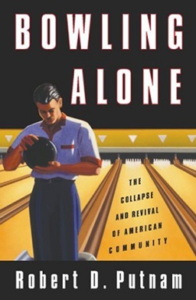 In 2000, the sociologist Robert Putnam raised awareness of our increasing isolation with his book Bowling Alone: The Collapse and Revival of American Community. He chronicles the decline in the average number of low stakes social contacts (aka casual friends) that Americans had in each decade since the middle of the 20th century. Many factors (such as commuting to work and watching television) have fed this trend, and a multifaceted response will be required to rebuild and strengthen our social fabric. The consistent theme is that we need more interpersonal connection.
 Since 2000, the trend has only become more noticeable. People have less time and fewer venues in which to cultivate casual friendships, which can mature into close friendships. However, we are not powerless. Christianity, by its very nature, is discovered and shared in community. People of many different ages and walks of life come to know God and grow in their experience of God by being part of a caring community in which they can explore and deepen their spiritual lives and form friendships that can be as casual or as close as the mutual friends are comfortable.
Think of the stories in which followers of Jesus encounter the risen Christ. Mary Magdalene cannot recognize him until he speaks her name. Travelers on the road to Emmaus cannot recognize him until they share hospitality and the bread and cup. Thomas thought he needed to have “hard evidence” to experience the hope of the resurrection, but what he really needed was to know that his relationship to God, as experienced in Jesus, was real. (see Deb’s letter, especially about the difference between the “achieving” and the “awakened” brain)
The resurrection is real. The presence of the Holy in yourself, your loved ones, and that person two pews over is real. That feeling you get when music allows the spark of the Divine to brighten to a warm glow inside you is not just a passing sensation. The growth of your willingness to take a personal risk to deepen a friendship or family relationship is not crazy; it is the Spirit coaxing you into a creative risk. Go ahead. Live a little, and then a little more.
In faith, with hope, for love,
Michael
From the Minister of Faith Formation
For it was you who formed my inward parts;
you knit me together in my mother’s womb.
I praise you, for I am fearfully and wonderfully
made.
Psalm 139: 13-14 (NRSV)
Dear Beloved of God,
In 2015, Lisa Miller, PhD., authored a ground-breaking book titled The Spiritual Child: The New Science on Parenting for Health and Lifelong Thriving. Her latest book, The Awakened Brain: The New Science of Spirituality and Our Quest for an Inspired Life, builds on her research about the effect of spirituality on mental health. I have not read her latest book; however, a colleague, Debbie Gline-Allen, Minister of Faith Formation for the Faith Formation Ministry Team of the Southern New England Conference of the UCC has shared her findings in a couple of recent blogs. You can read Debbie’s most recent blog at: https://www.sneucc.org/blogdetail/17390136.
Miller defines spirituality as “an inner sense of relationship to a higher power that is loving and guiding. The word we give to this higher power may be nature, God, spirit, the universe, the creator or others which represent a divine presence.” We are foundationally, inherently and genetically spiritual beings; from day one we are born with a capacity for transcendence. Many of us are aware that the youngest among us are indeed spiritual beings. How faith communities nurture the spiritual life of the youngest among us is important especially in the first 10 years of their life. How faith communities assist families in offering opportunities for meaning and memory making is important to their physical, emotional, social, spiritual and intellectual health. It is imperative that none of these areas are neglected.
Miller also offers six spiritual strengths: 1. a child’s spiritual compass is trustworthy and good for life, 2. children are hardwired to hold family sacred and sustaining, 3. spiritual community gives your child an expanded family of kindred spirits, 4. spiritual multilingualism (seeing the sacred in others and diverse traditions) is your child’s passport, 5. spiritual agency empowers children to create a culture of love, 6. transcendent knowing: dreams, mystical experiences, and other special knowing.
There is an engaging YouTube video conversation with Lisa Miller and Professor Stephen Kelleher titled The Awakened Brain: The New Science of Spirituality and our Quest for an Inspired Life. In the video the two spend time discussing the achieving (transactional/utilitarian) brain and the awakened (transformational) brain. The achieving brain has to do with having more and the awakened brain has to do with being more. https://www.youtube.com/watch?v=8IOJeBAIVB4.
On April 18th and 19th, I attended the 2023 Children’s Spirituality Summit regarding Generation Alpha (those born between 2010-2024). Primarily children of Millennials, Alpha’s are the first generation entirely born into and shaped by the 21st century. They are “digital natives” having no prior experience of life before cell phones, iPads, computers, etc. Mark McCrindle (https://mccrindle.com.au) coined the term Alpha as having reached the end of the alphabet we are most familiar with, he transitioned to the Greek alphabet.
In response to the types of stress (Sprenger 2008) that children and youth face The Harvard Center for the Developing Child (https://developingchild.harvard.edu) states that children need:
The availability of at least one stable, caring, and supportive relationship between a child and the important adults in his or her life. These relationships begin in family and can include neighbors, teachers, social workers, coaches and I would add members of their faith community.
Helping children build a sense of mastery over their life circumstances to adapt positively to adversity.
Children who develop strong executive functions and self-regulations skills are able to manage their behavior and emotions and adapt strategies to cope effectively with difficult circumstances.
The supportive context of affirming faith or cultural traditions. Children who are solidly grounded within such traditions are more likely to respond effectively when challenged by a major stressor or a severely disruptive experience.
Some other, still forming characteristics of Generation Alpha: they are activists with a deep responsibility to reverse the damage of past generations; which includes systemic injustices prevalent in our world; they are influenced by activists not too much older than themselves – like Greta Thunberg; they are super informed and constantly connected; they will likely stay in education longer; start their earning years later and so stay at home with their parents later then even their predecessors, Gen Z and Gen Y; they may be particularly impatient as they are used to technology fulfilling their desires from an early age; they are inclined to break free from existing structures and institutions (including church); they will face questions that haven’t been named yet, so that adults who have gone before them will need to be present and receive their questions without judgement or fear.
I pray that Generation Alpha (and all our children and youth) will know this chant based on Psalm 139: 13-14, taught to us by Jeff Olmsted, and which has become part of the opening ritual in church school:
I am wonderfully made, named, and claimed by God.
You are wonderfully made, named, and claimed by God.
We are wonderfully made, named, and claimed by God.
And I pray that we as a faith community will actively, lovingly, and faithfully minister to our church school families in meaning making and memory making ways that support their faith and spiritual well-being.
Blessings,
Deb
To read the full SPIRE click here.