Plus ca change, plus c’est la meme chose.
Dear Edwards Church Community,
The French saying means “The more things change, the more they stay the same,” and has an English equivalent: “Everything old is new again.” The book of Ecclesiastes in the Hebrew Bible, which predates both by centuries, declares: “What has been will be again, what has been done will be done again; there is nothing new under the sun.”
While these statements describe some truth, i.e., that there is a lot of repetition in life, they do not capture the whole truth. In nature and in human history, life that extends across generations must necessarily adapt and change to keep living. For what has been to continue to be, it must have both continuity and change. Biology shows this perhaps most clearly, but the same holds true in the life of the church.
 The United Church of Christ declares in the preamble to its constitution: The UCC “claims as its own the faith of the historic Church expressed in the ancient creeds and reclaimed in the basic insights of the Protestant Reformers. It affirms the responsibility of the Church in each generation to make this faith its own in reality of worship, in honesty of thought and expression, and in purity of heart before God “ Plus ca change, plus c’est la meme chose.
Our local church declares in its bylaws: “The purpose of this Church, in all its programs and activities, shall be to bind together followers of Jesus Christ for sharing in the praise and worship of God and in seeking and serving God. As Christians, it is our mission to respond to all God’s creation with the love Christ directs, through collective and individual worship, prayer, support, and action.” We bind together followers of Jesus to share in praise and worship and in seeking and serving God.
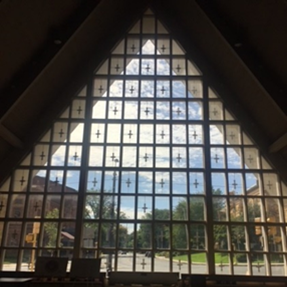 I deliberately leave out “Christ” in that restatement to leave room for those who struggle with the theological claim that the historical Jesus was all the Christian tradition says, because the UCC welcomes all who are otherwise engaged in worship, praise, seeking and serving. As our Vision Statement says, “Gathering at the crossroads of ancient faith and contemporary culture, we are a Christian church asking God to open us to a new way.”
For much of the past two years, the crossroads of our lives has been littered with the wreckage of Covid-19. For many, the patterns of life have been first shattered, then forcibly adapted. The ways we worship have begun to evolve. We cannot say the change will ever stop, and we cannot yet say if we are changing fast enough to do more than survive – but to thrive – and what that will look like.
If we believe our thriving depends on our cleverness, we are already lost. Our cleverness will be helpful. If we remember that our life as a church and all our thriving ultimately depends on the grace of God, to which we can make ourselves available but which we can never control, we will do more than just survive. We will thrive.
In faith, with hope, for love,
Michael
From the Minister of Faith Formation
Dear Beloved of God,
On entering the house, they saw the child with Mary, his mother;
and they knelt down and paid him homage.
Then, opening their treasure chests, they offered him gifts of
gold, frankincense, and myrrh.
Matthew 2:11 (NRSV)
“Epiphany” comes from the Greek word Epiphaneia, which means ‘manifestation’ or ‘appearance’. Celebrated on January 6 it is also called the twelfth night as it falls twelve days after Christmas, the season goes to Ash Wednesday. The festival of Epiphany dates back to the 4th century and celebrates the arrival of the Magi (Greek for wise men) also referred to as kings, or astrologers at the home where Jesus lived (he was about 2 years by then) and the presentation of their gifts to him.
Epiphany is often called “Universal Christmas” as it retells the disclosure of Jesus to the Gentiles. In the Hebrew scriptures, God seemed mainly concerned with the Hebrew people; now in the gift of God’s only Son, the angel proclaimed God’s love for all people. “Do not be afraid; for see – I am bringing you good new of great joy for all the people: to you is born this day in the city of David a Savior, who is the Messiah, the Lord. (Luke 2:10)
On Christmas Eve we lit the Christ candle and will continue to do so during Epiphany a reminder that as we walk together in a world where darkness – an overarching metaphor for the many ways in life that are difficult and how human experiences can shut out joy, light will endure.
In the opening verses of the Gospel of John we read that John the Baptizer came into the world to testify that the true light which enlightens everyone, was coming into the world and that his life was the light for all people. This light shines in darkness and the darkness did not, will not overcome it.
In their book, The Circle of Life: The Heart’s Journey Through the Seasons Joyce Rupp and Macrina Wiederkehr, write: “The Christian season of Advent has as its central theme the coming of the Christ-Star into the world. It is a time to remember how God’s Beloved came to restore harmony to a fractured world, to dispel whatever keeps love from shining through all beings.”1 We are reminded that we are reflections of God and the light Jesus brought into a world not so unlike our world today.
“Just as a star led the Magi to the Christ Child, so we are meant to be stars leading others to the Divine Love. Others are also stars for us, leading us to Divine Love. In each of us the manifestation of Divine Love is a magnificent gift of hope and encouragement.”2
While we will still have COVID and it variants with us along with the pandemics of racism, environmental crisis, immigration crisis, white supremacy, etc., as we begin a new year, I pray that we will be as stars shining brightly for one another and that the reflection of God’s Divine and Radiant love in each of us continues to shine brightly through our various ministries, our discipleship, our daily living. I pray that we will let others be as stars for us shining and reflecting God’s Divine and Radiant love within them.
Blessings God’s Divine and Radiant and love,
Deb
- Taken from The Circle of Life 2005 by Joyce Rupp Macrina Wiederkehr. Used by permission of Ava Maria Press. All rights reserved.
- Ibid.
To read the whole SPIRE click here.