On our best days, Christians believe God’s most significant act of love put God right in
the middle of our messy, dangerous world – as a tiny embryo implanted
in the uterus of a teenage girl, as a hungry newborn rooting for his mother’s
breast, as a man who drank at weddings and cried at funerals,
as a human being whose heart broke and soared and skipped beats and,
one day, stopped. Because true love can never be coerced or controlled,
God does all this without the guarantee of reciprocation.
Rachel Held Evans, Wholehearted Faith
Dear Edwards Church Community,
 I have loved Christmas longer than I can remember and still marvel at its glittery presentation: the tree that twinkles, the star that shines, and even the red nose on a reindeer. I love the smells of familiar foods that fill the air, lifting spirits as they waft through homes. But most of all I am comforted every year by the message we find so many ways to share.
God loves us so much that God became one of us, subject to all the joys and sorrows that come along with being human: the joy of having families and friends, and the sorrow of having to live with lost loved ones or broken relationships; the joy of sharing meals and sharing lives, and the sorrow of illness and death. Jesus knew all our human experiences fully and directly, so God knew and knows them fully and directly too.
Rabbi Abraham Joshua Heschel wrote that the God we know through the Bible is not the “unmoved mover” posited by philosophers. Rather, the Biblical God is the “most moved mover,” one who takes a deep interest in all of God’s creation and each of its creatures. Christians, as Rachel Held Evans wrote, “believe God’s most significant act of love put God right in the middle of our messy, dangerous world”.
That is not the end of the story, but only its beginning, as we sang on the first Sunday of Advent:
O how shall I receive you, how meet you on your way;
blessed hope of every people, my soul’s delight and stay;
O Jesus, Jesus, give me now by your own pure light,
to know what e’er is pleasing and welcome in your sight.
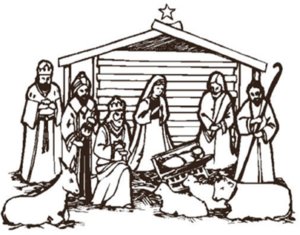 Of course, much of the rest of the church year is dedicated to reminding ourselves what is pleasing to Jesus, as we are challenged and encouraged, called and led by the life and teachings, death and resurrection of Jesus.
For now, it is enough to simply celebrate God coming to us, as fully formed as any newborn, and offer ourselves in service to his growth and maturation in out midst. For the incarnation, begun and completed in the person Jesus, is still to be realized in every generation of the body of Christ, the living local community of our church.
In faith, with hope, for love,
Michael
From the Minister of Faith Formation
Dear Beloved of God,
For some time now, I have begun my Spire letter to you with “Dear Beloved of God.’” Increasingly each month, my thoughts regarding this salutation have led me to wonder and reflect on what does being a beloved child of God mean to each of us? That leads me to further wonder how we live out our belovedness as children of God? How do we affirm the belovedness of those we may not agree with or relate to?
In conversation with every Search committee and Faith Formation Team (committee) when asked what forms my hope and basis for faith formation for children, youth, and adults, my response has always been: if nothing else, that each will know that they are a beloved child of God. That encompasses nothing short of life long spiritual/faith formation in the world we find ourselves in.
Henri J.M.Nouwen in his book Life of the Beloved: Spiritual Living in a Secular World, which he wrote in response to a challenge from journalist Fred Bratman, states: “becoming the Beloved is the great spiritual journey we are called to make once we claim that truth that we are Beloved.”1 Nouwen suggests a four-fold path to listening to the movement of the Spirit in our lives and devotes a chapter to each: taken (chosen), blessed, broken, and given.2 This comes from his call as a Christian to become bread for the world: bread that is taken, blessed, broken, and given.
In the opening paragraph of the chapter titled Blessed, Nouwen states “that as Beloved children of God we are blessed.”3 Based on personal experience, he offers two suggestions for claiming and living our blessedness: prayer and presence. On advice from the Hindu spiritual writer Eknath Easwaran, Henri was encouraged to learn and repeat a sacred text over and over while in prayer. He spent many of his half hours of prayer slowly repeating the Prayer of St. Francis:
Lord, make me an instrument of your peace:
where there is hatred, let me sow love;
where there is injury, pardon;
where there is doubt, faith;
where there is despair, hope;
where there is darkness, light;
where there is sadness, joy.
O divine Master, grant that I may not so much seek
to be consoled as to console,
to be understood as to understand,
to be loved as to love.
For it is in giving that we receive,
it is in pardoning that we are pardoned,
and it is in dying that we are born to eternal life.
Amen.
Perhaps there a scripture such as Psalm 46:10 “Be still and know that I am God”, or a prayer such as The Lord’s Prayer, or the Metta Prayer (Loving Kindness Meditation) or a spiritual practice such as walking the labyrinth that you spend time with as you listen for God.
The cultivation of presence in claiming and living our blessedness involves being attentive to the blessings that come to us day after day and year after year. It involves putting aside our busy, hectic schedules, the injustices of this world (Nouwen does acknowledge what he refers to as the curses in the world)- all that prevents us from being silent to listen for our still speaking God who claims all as Beloved and desires all to live out that claim in our lives and the world.
In this life long journey and as we head into the liturgical season of Advent, how might we (I) claim and live out our (my) belovedness in the themes of this season? How might we share our belovedness as blessings of hope, peace, joy, and love to others in this time? Might we be attentive to receiving and acknowledging the blessings we experience and receive them as such.
Dear Beloved of God, wishing you the blessings of hope, peace, joy, and love in this Advent season and beyond.
Deb
- Nouwen, Henri. Life of the Beloved: Spiritual Living in a Secular World. The Crossroad Publishing Company, NY. 1992. pg 43.
- Ibid. pg 49
- Ibid. pg 67
To read the full SPIRE click here.