Dear Edwards Church Community,
“We make a living by what we get. We make a life by what we give.”
– Winston Churchill
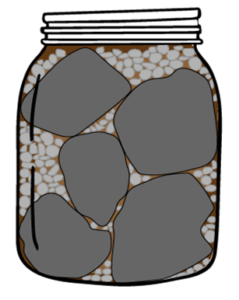 There is so much we could worry or get upset about. There is also so much to celebrate and be grateful for. A lot depends on how you want to fill the time of your life, how you want to use your energy and attention.
A familiar image for time management encourages us to organize our lives the same way we would pack rocks, small stones and sand into a jar: the big rocks (our most important commitments) go in first and occupy most of the cherished space in our cramped schedules; smaller stones (significant but of less urgency or importance) go in around them; finally, there is the sand of our lives, stuff we all have to do that plays a role but which we must, when time is short, simply allow to wait.
In a similar fashion, we can be intentional about how we choose to feel about different things, causes, and even people. On a recent episode of the radio show and podcast Freakonomics, called “How Can We Break Our Addiction to Contempt?” (https://freakonomics.com/podcast/arthur-brooks/) the host interviewed Arthur Brooks, who has made his living as (in this order) a professional French horn player, a professor of economics and social scientist, the President of the American Enterprise Institute (a conservative think tank), and now as a professor, writer and public speaker.
 Brooks has investigated the psychology and neuroscience of how to change his habits of thought and feeling, especially his negative reaction to certain ideas and the people who espouse them. He once asked the Dali Lama what to do when his first reaction was to feel contempt. The answer: “Practice warm heartedness.”
Notice the first word: “Practice.” It is a chosen response. This practice is made more demanding and more necessary by the well documented tendency of social media and echo chamber media outlets to deliberately stoke our outrage in the service of theirbusiness bottom line.
Brooks is currently a professor at Harvard, teaching in the college and the Kennedy School of Government. Skeptics may suspect he is out of touch. But he is, by nature, a smart and curious person who follows his passion and uses his intelligence and research skills to learn more about what is important to him. Right now, that is learning whether and how the American experiment can survive and thrive. For Brooks, social science and spiritual practice converge. His most recent book is titled Love Your Enemies.
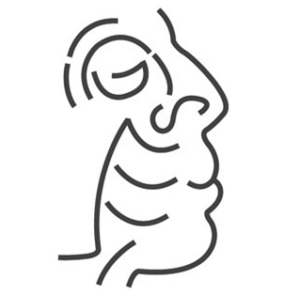 In a class on happiness, Brooks has his students enact the Duchenne smile so that they can experience the biofeedback. (The Duchenne smile, named for the 19th century anatomist who discovered its properties, has been shown to induce a pleasure response by engaging all the same muscles used when we naturally express pleasure with a smile so big and deep that we get crow’s feet.) Learning to practice warmheartedness can be pleasant. Many of us are unknowingly habituated to activating our dopamine receptors by getting upset – outraged by the news or something on social media. We can reverse that, but first we must want to change it.
America has a history and a future, just like everyone who inhabits it: the Native Americans, who were here first; the European colonists, who came to be the dominant inhabitants; and more recent immigrants, who have been coming for generations for diverse reasons but with a common goal – a better life.
“We make a living by what we get. We make a life by what we give.” In this season of Thanksgiving, may we all have time to reflect on all the good in our lives. And when confronted by whatever triggers our outrage, try responding only after a deeply sincere smile.
In faith, with hope, for love,
Michael

From the Minister of Faith Formation
Dear Beloved of God,
Come and Experience the Labyrinth
November 21 @ 3:30 & December 21 @ 3:30 in Addis Hall
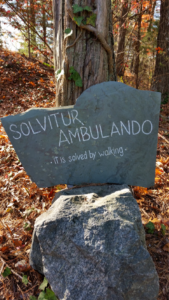 The Labyrinth Ministry Team invites you to come and experience the spiritual and physical practice of walking a labyrinth. Lauren Artress, author of Walking a Sacred Path: Rediscovering the Labyrinth as a Spiritual Tool, writes: “Walking the labyrinth is a body prayer. It is non-threatening; all we are asked to do is walk. Walking the labyrinth clears the mind and gives insight into the spiritual journey. It calms people in the throes of life transitions. It helps them see their lives in the context of a path, a pilgrimage. They realize that they are not human beings on a spiritual path but spiritual beings on a human path.”
Jill Kimberly Hartwell and Elizabeth Catherine Nagel, in their book, The Labyrinth and the Enneagram: Circling into Prayer, write: “The labyrinth is a place where we discover in new ways how God is present with us as we walk through life. Some people report feeling calmed, centered and connected, truth emerging from the inside out, a synchronizing of body, breath and imagination, or a noticing of what was not evident after walking a labyrinth.”
People walk the labyrinth for many reasons: prayer, inspiration, guidance/clarification, meditation, relaxation, movement, ritual, a desire for wholeness and wellbeing, or deepening a relationship with the Divine are just a few.
Theresa of Avila, a 16th century mystic coined the phrase “threefold path” which is often used as a guide for experiencing the labyrinth. Upon entering the labyrinth, which has one way in and one way out, we are encouraged to release, or let go of our many roles and demands, feelings of anxiety, guilt, worry, etc. Entering the center is a time to receive, to pause, to be open, receptive, and even expectant to what may come: peace, clarity, insight, guidance, forgiveness. After taking as much time as needed in the center to stand in the mystery or listen for an inner voice, we return on the same path we entered.
Similarly, in a Labyrinth Ministry class at Andover Newton Theological School, the three movements were described as moving inward: a time to cast off discard, divest, unwrap forget, centering: a time to be open, expectant, and receptive, as though we were receiving a gift, and moving outward: a time to gain direction, satisfaction, comfort, and new energy.
There is no right or wrong way to walk a labyrinth. I have seen people skip, crawl, pause in various places, dance, and sometimes sing as they move through the labyrinth. Some people walk with their hands folded prayerfully, others with arms crossed over their heart, by their side, or extended in front or beside them. Many people bow before entering and after exiting the labyrinth. All are encouraged to be keep an open mind throughout their walk.
For many who experience the labyrinth on a regular basis (myself included), it is a clearing, cleansing, and balancing ritual for their spirit.
Pre-COVID, the team offered labyrinth walks to mark the winter and summer solstices and the spring and fall equinoxes. Most recently it was offered as an intergenerational station during our Look Park worship.
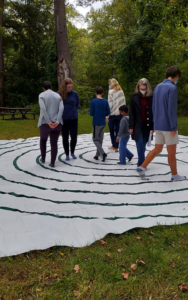 The theme of the November walk will be thanksgiving and the theme for December will be centered around the winter solstice. Participants will be required to be masked and to remove footwear before walking the labyrinth. Available will be samples of different labyrinths: a hand held pewter one, a wooden lap one, an 18” by 18” cloth one, and some paper finger labyrinths. Whether you have walked a labyrinth before or are curious about this physical and spiritual practice, I hope you will experience one or both of these offerings.
For more information about labyrinths visit: www.labyrinthsociety.org.
On a local note: Sr. Lorrie Villemaire, of the Sisters of St. Joseph (from whom we purchased our portable labyrinth) some years ago developed a 12-week Labyrinth Program at the Hampshire County Jail and House of Correction in Northampton. In 2010 that led to the construction of an outdoor labyrinth at the Jail and House of Correction (not open to the public). One inmate quoted in a 2013 article in the Gazette said: “the labyrinth is a place where you can be a free man even though you are locked into a facility.”
Blessings,
Deb
To read full SPIRE click here.
To view “Experiences with the Divine” click here.