Dear Edwards Church Community,
“Let’s add patience to the list of requirements Governor Charlie Baker laid out an May 18 for restarting the state’s economy.” So begins a Boston Globe article about the re-opening process.
 In a recent UCC Daily Devotional, Rev. John Edgerton writes about the struggles faced by Noah and his family. The rains that produced the flood lasted 40 days and 40 nights, Biblical code for long enough to feel it might never end.
Then the rain ended, but the flood did not. Noah and his family were still in the ark for 150 days, longer than we’ve been under any kind of stay at home order or physical distancing. People of faith have been here before. We how to share resources for coping and feeding our faith, so we can keep coping, feeding our faith, and loving our neighbor.
Here are links to two recent daily devotionals on the theme of becoming more patient by allowing yourself to grow the patience you need. The one about Noah’s ark from John Edgerton and another from Rev. Kit Novotny about dealing with children’s sense of time.
John: https://www.ucc.org/daily_devotional_wait_how_long
Kit: https://www.ucc.org/daily_devotional_the_longest_shortest_time
Taken together they challenge and comfort me, like a rod and staff, because they remind me that, with God’s help, I can always become more patient. Unfortunately it takes a bit of hard-won patience to have a foundation on which to grow more patience – like muscle mass or starter dough – especially when patience is wearing thin. But with faith, we can grow more patience. We may well need it.
Maybe you have noticed that the pandemic has exposed things – call them cracks in the system, any system – that were already there, just below the surface. Stress will do that. Flaws in a structure or a relationship are exposed by stress. A minor crack becomes a bigger gap. An inter-personal annoyance, relieved by leaving the house for work every day, or leaving the work place to go home, becomes an inescapable difference needing to be addressed.
Then there are persistent economic disparities that trouble us, just not enough to insist they be addressed structurally, because that would be “political” and there is always tomorrow. And there are those darn partisan political divisions that confront us daily, until we wish they would just go away. Perhaps what we fear from the pandemic is not just the disease, but the things it pulls from the periphery, plunks down center stage, and threaten to tear us apart.
My dear old Dad used to pray aloud at dinner, when the table got too noisy, “God, give me strength, patience, fortitude, and long suffering. Actually, I already have the suffering, so just help with the rest.” Then he would smile at us and keep eating.
Consider this Venn diagram, which has been floating around social media:
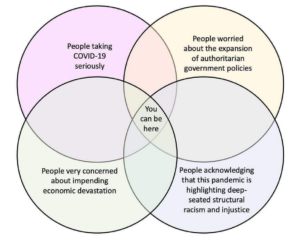
I identify with the person who says, “I take COVID-19 very seriously.” I think we all know it is real, but because we are still learning about it, we give it different levels of respect. No one really knows what percent of infected people are likely to become symptomatic, need to be hospitalized, or die. But we do know that the virus is effective at spreading among humans, especially when they gather indoors.
The late Daniel Patrick Moynihan wrote, “Everyone is entitled to his own opinion, but not his own facts.” COVID-19 is contagious. In four months it has killed more residents of the United States than the entire Viet Nam War. We do not have a vaccine to prevent the spread or effective therapies to reverse the symptoms. Physical distancing has been effective at dampening the spread. Those are facts.
I also count myself in this category: “People very concerned about impending economic devastation.” Who wouldn’t be? We all know people who have lost jobs. Many of us know businesses at risk, restaurants that have already closed forever. This devastation is not pending; it has started and is not over. No one wants suffering to continue, but I’m also not rushing to visit any restaurant or theater.
The first job of leadership is protection, preserving the lives and welfare of the people who have placed trust in their leaders. Among the hardest choices a leader can make is to deliberately disappoint those who have trusted them. Forced to balance competing interests, our political leaders carve a path between preserving lives and preserving businesses and jobs, trying to strike the right balance, which can only really be known after the fact. We all have opinions; some important facts are still unknown.
I am also one of these: “People worried about the expansion of authoritarian government power.” In some states, governors have been sued by groups of citizens or legislators to force the re-opening of businesses. The legal argument is usually based on the constitutional principle of separation of powers, with the complaint being that the chief executive has usurped the role of the legislature.

A chief executive needs to be able to act in an emergency to protect the people. At a point in time, when weeks or months have passed and the emergency is likely to last a lot longer, then the legislature can and should get involved to balance competing interests.
This is the premise of the long-ignored War Powers Act, passed to require U.S. Presidents to obtain congressional authorization to make war when there is no imminent threat. When a legislature is willing to wait while the executive acts, that is usually a good indication that it perceives one of two things. Either the chief executive is acting with the support of most citizens or the issues are so difficult the legislature will let the executive take the risk. When the legislature cannot act due to internal division, that allows the executive to assume more power with less checks on it.
Governors are not the only chief executives willing to exercise their authority in ways that stretch limits. The U.S. Supreme Court will be deciding in the coming months whether the President may exercise all the powers and enjoy all the privileges his lawyers claim. This controversy has been brewing for decades, with Presidents of both major parties pushing the limits, but recent events have brought it to a head.
Stress deepens and exposes flaws in a system. Fixing them before lasting damage occurs requires patience with each other. One wonders if that is a lost art.
Finally, I need to say that I am also one of these: “People acknowledging that this pandemic is highlighting deep-seated structural racism and economic injustice.” Early in the pandemic, some said it would show how we are all the same, because people of every nation, race, ethnicity, class, religion, or other distinction are all human and share the same vulnerability. What the virus has really shown is how much we are not the same in terms of who is at risk. People who are poor and people of color are bearing a disproportionate burden in terms of illnesses and deaths.
Patience is a virtue. We all stand to benefit if we can be patient when needed. But there are still times when it is more faithful or necessary to act than to wait. We are forming an ad hoc team to plan for re-opening. There is much to consider and plan. Patience will help us there.
Meanwhile, the Outreach Grants Ministry Team has increased Edwards’ support for the Survival Center and is in close contact with MANNA, Cathedral in the Night and Friends of Children. As a church, we are responding by offering increased financial and other support to local non-profits that provide direct services to those most affected by the health and financial impact of the pandemic. Please pray for all of them as well.
We will get through this, together.
Blessings,
Michael
Read the whole newsletter here.