Dear Edwards Church Community,
As we turn the page on 2019 and prepare for another lap around the sun in 2020, I wonder how we might get closer to our aspirational goals over the coming year. How might we more fully realize the vision we have claimed?
Gathering at the crossroads of ancient faith and contemporary culture,
we are a Christian church asking God to open us to a new way.
 This year we have begun to live into the process approved at our last annual meeting for a more deliberate use of our inherited wealth. I know it makes some of us uncomfortable to use the term “inherited wealth,” but I cannot think of a more accurate term. As a church, even if not as individuals, we have the advantage of significant resources passed down from prior generations. Being deliberate about how we use them and share them is not only appropriate but mandatory if we are serious about following Jesus.
At the upcoming annual meeting scheduled for January 26, 2020, we will consider the proposal of the REACH team to change how we organize the work of the church. It feels like we are continuing to be open to new ways.
Encountering the worlds joys and suffering,
we offer ourselves as instruments of love and justice.
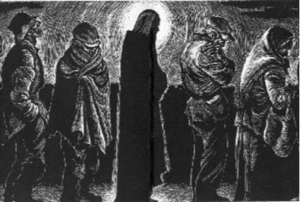 This community of faith has a well-deserved and growing reputation for walking the talk of service to the wider community. The participation of Edwards Church in the formation of the Survival Center, the MANNA Soup Kitchen, the Interfaith Emergency (“Cot”) Shelter, Cathedral in the Night, and other area non-profits is well known. Our ongoing support for them and other ministries and non-profits is evident in the volunteer hours and other forms of support we provide.
Our church’s support of refugees through the Circle of Care and our commitment to be a member of the support network for transgender asylum seekers are further extensions of our ongoing commitment to be instruments of love and justice. We have a lot to celebrate.
Knowing that the road is long, we choose to walk together.
Finding strength in our diversity, we call on all our talents to worship and serve.
Longing to find the holy in ourselves and others,
we listen for God’s still-speaking voice.
True confession: these three separate stanzas of the Vision Statement tend to merge in my thinking about our church community. They express commitment to walk together and to find strength in diversity. They acknowledge a longing for discovery, and they embrace listening as the way to satisfy that same longing.
We do not always agree, or we would not need to choose to walk together. Rather, we would simply do that without thinking about it. We need to declare that we find strength in our diversity, because in so much of the culture at large (which conditions most of our behavior) we avoid exploring real differences because of the risk it will devolve into more of the endless conflict we see all around us.
Our national government seems incapable of constructive dialog. What makes us believe we can do better? Maybe the fact that we are a Christian church, not the secular government, maybe the notion that we trust God to be with us and guide us as we open up to new ways. If we cannot practice together living the values we claim, then we may as well pack it up and go home.
 Working through the details of greater sharing of our inherited wealth and revising our organizational structure are bound to bring up some differences. I believe this community already has all we need to face our differences as a source of strength. I also believe that doing it will require leaning into our longing to find the holy in ourselves and others. All we need is to become even better listeners, and we’re open to that!
A recent article in the New York Times offers advice on “How to Argue on the Internet Without Losing Your Mind.” The specific recommendations are: (i) practice empathy, (ii) stop if you’re in a bad mood, (iii) take your time, (iv) pay attention to language, and (v) limit your replies. I recommend it to anyone interested in being a better dialog partner online or anywhere: https://www.nytimes.com/2019/12/12/smarter-living/how-to-argue-on-the-internet-without-losing-your-mind.html
Similar notes were sounded by Lawrence Bacow, the President of Harvard University, who spoke last fall at a morning worship service about the university’s need for and commitment to mutual respect while pursuing the truth. Those comments follow this letter in the Spire.
The need for guidelines, i.e., some sort of “rules of the road” for congregational conversations, is well recognized. Unfortunately, it most often arises in the wake of conflict that becomes harmful. One of the most effective tools churches have for keeping conflict constructive is a behavioral covenant, which is a written reminder of the community’s shared commitment to certain values and practices, especially when approaching sensitive topics.
With other pastors in New England, Deb Moore and I have been fortunate enough to be on the staff of churches with these covenants. Both were developed with support from an organization called Walking in the Way of Peace. Our neighbors at Easthampton Congregational Church developed one in 2012 in the wake of some rough waters they had to navigate together. Not surprisingly, these covenants resonate with the advice in the NY Times article: start with empathy. Take your time. Watch your words.
We are already on our way, because we have already chosen to walk together, to find strength in our diversity, and to listen for the voice of God in each other.
Wishing us all peace, health, and deepening faith in the New Year,
Michael